Varroa destructor is a mite that parasitizes honey bees (Apis mellifera L.) and is one of the leading causes of colony losses worldwide. High infestation levels lead to a reduction in bee lifespan, virus transmission, immune system suppression, and a decline in colony strength (both in population and food reserves). For this reason, beekeepers continuously strive to reduce mite levels through different management techniques, including acaricide treatments.
Traditional treatments for varroa control
Since the emergence of varroa, synthetic acaricides have traditionally been used, such as pyrethroids, organophosphates, or amitraz.
Their widespread use has generated strong selection pressure on the mite, resulting in resistant populations to certain active substances.
New treatments against varroa: organic acids
In this context, organic acids have emerged as a complementary solution to synthetic molecules within an integrated varroa control strategy.
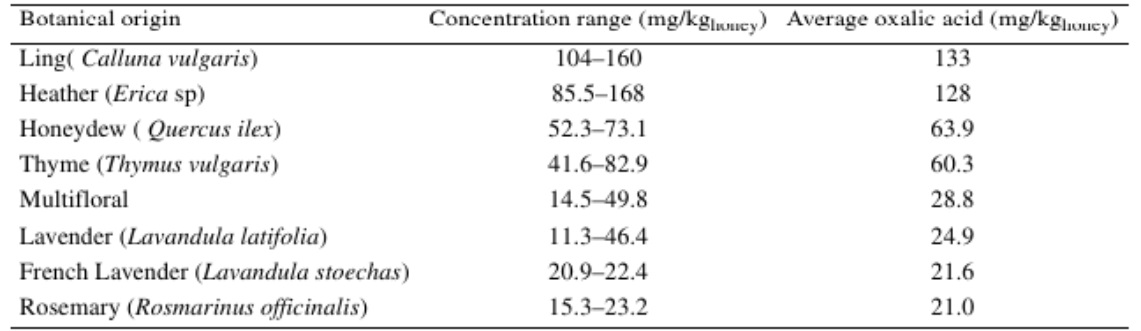
Among these is oxalic acid. This substance occurs naturally in honey in small amounts, as shown in the following table (Nozal et al., 2003):
This acid has been used for varroa treatment since the 1980s. Its mode of action is based on the direct contact effect it has on the mite, thanks to its low pH (high acidity). The acid damages both the cuticle and the sensory organs of the mite, increasing mite fall in the days following treatment.
Oxalic acid does not kill mites present in the brood under capped cells, so to achieve high treatment efficacy it is recommended to apply it during broodless periods or when brood levels are low.
How to apply oxalic acid for varroa treatment
As with any veterinary treatment, the method of application is just as important as the active substance itself. Dribble, spray, or sublimation treatments remain active for approximately 3-4 days, since the molecule loses activity once dehydrated.
In Europe, oxalic acid was only registered for use in these ways, as animal welfare regulations are very strict and limit its use to one or two applications per year.
It became necessary to find a way to apply oxalic acid so that it remains active for a longer period and continues controlling mites emerging from brood cells, without harming developing bee brood.
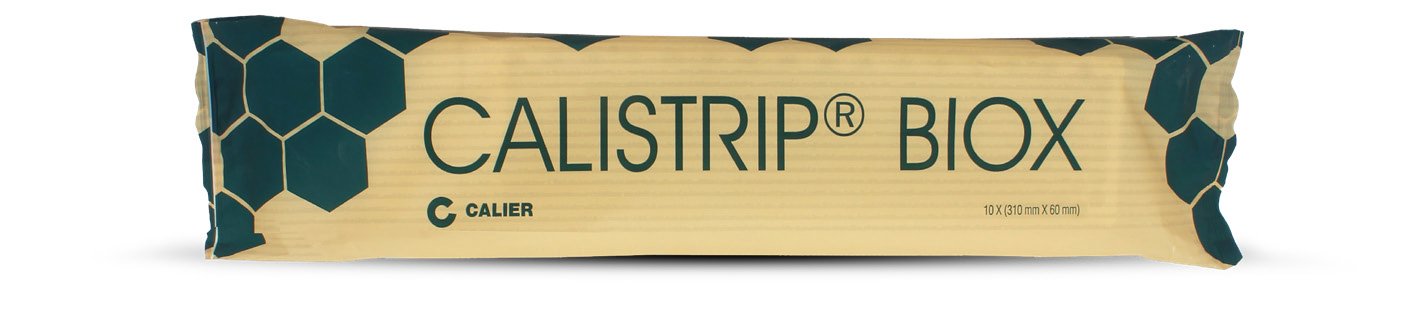
The alternative for colonies with brood is Calistrip® Biox, strips that guarantee product effectiveness for 6 weeks, allowing control of both phoretic varroa (on adult bees) and mites present under capped brood as new bees emerge. The extended treatment duration compared to other oxalic acid application methods ensures mite control throughout at least two bee generations.
Advantages of oxalic acid treatment
One advantage of using oxalic acid, compared with other organic treatments such as formic acid or thymol, is that it does not depend on ambient temperature, since its efficacy is not based on compound evaporation.
As a contact product, it only requires colony activity and a sufficient bee population.
One of the negative impacts of traditional acaricide treatments for varroa control is the possible presence of residues in bee products such as honey, pollen, or propolis.
The use of oxalic acid avoids this issue because it does not accumulate in honey (Bogdanov et al., 2002), nor in wax (Rademacher & Harz, 2006).
As in all livestock production systems, veterinary treatments should be part of an integrated farm management strategy. To effectively control varroa, beekeepers should also consider practices that improve treatment efficacy: regular monitoring, taking advantage of swarming periods, queen caging, or treating during summer brood interruption periods.
Bibliografía
Bogdanov, S., Charrière, J., Imdorf, A., Kilchenmann, V., Flur, P. 2002. Determination of residues in honey after treatments with formic and oxalic acid under field conditions. Apidologie, 33:399-409. DOI: 10.1051/apido:2002029
Nozal, M.J., Bernal, J.L., Gómez L.A., Higes, M., Meana, A. 2003. Determination of oxalic acid and other organic acids in honey and in some anatomic structures of bees. Apidologie, 34:181-188. DOI: 10.1051/apido:2003001
Rademacher, E., Harz, M. 2006. Oxalic acid for the control of varroosis in honey bee colonies-a review. Apidologie, 37:98-120. DOI: 10.1051/apido:2005063

 21 Jun 2023